



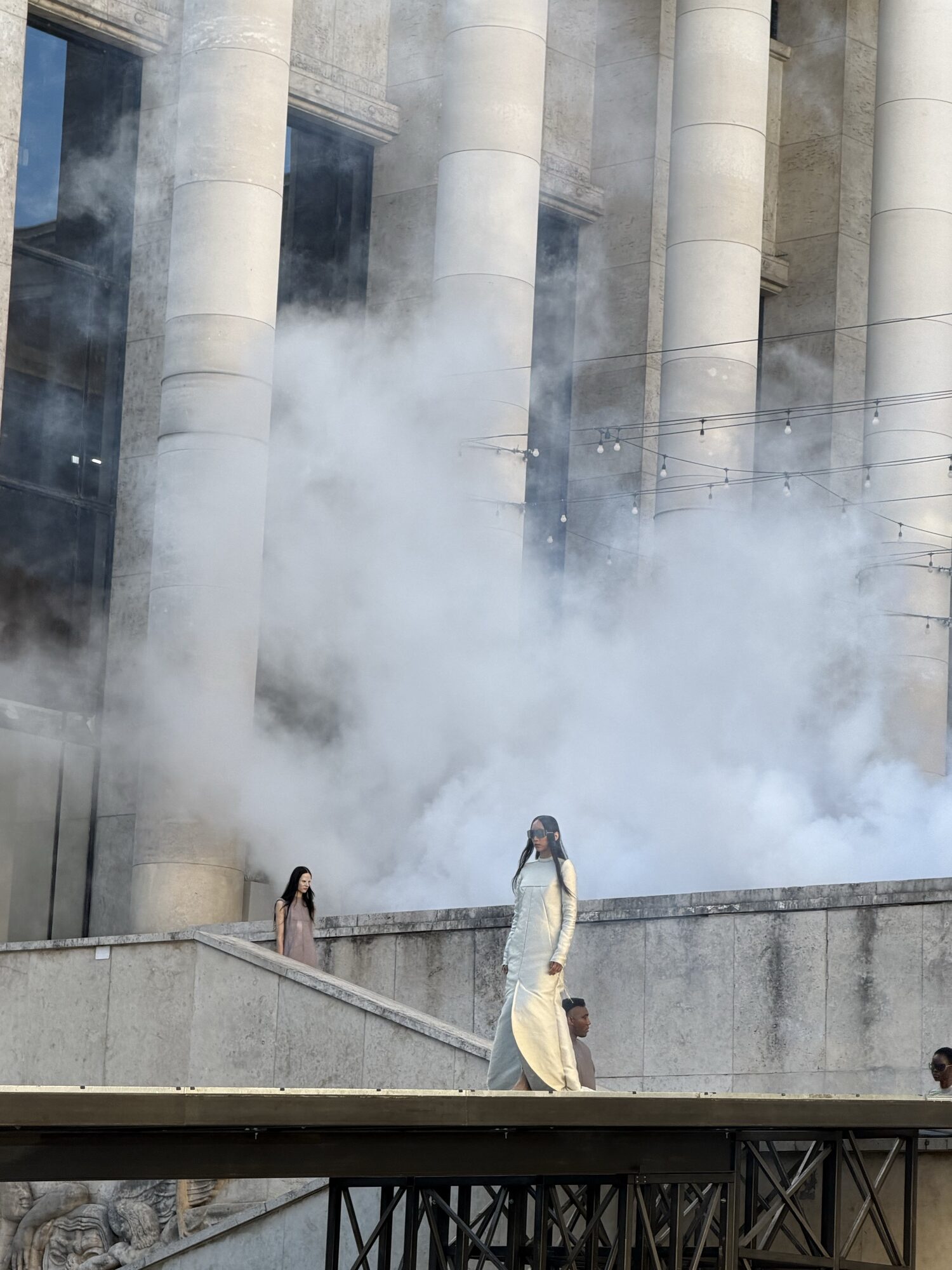
It was a beautiful day in Paris. At the Palais de Tokyo, a long runway crossed the reflecting pool, with fountains rising on either side. They were turned up so high that the spray drifted over the audience. Paisley and I were in the splash zone. The music was loud and dramatic, as always; the fountains made the show’s atmosphere physical. Water reached us as a fine rain. We were still spectators, but no longer entirely outside the scene.
That small change in our position stayed with me. A runway usually asks us to look: at a body, a garment, a sequence of images moving past. Here, the view kept being interrupted by water and light. The collection moved through a landscape that reflected it back, while the spray crossed the distance between the show and the people watching. The effect was not simply spectacle. It made the boundary between looking and taking part feel less fixed.
The collection was titled Stone. Owens gives the word several lives. It can suggest composure and endurance. It can be the stone moved aside at the Resurrection, an obstruction removed after sacrifice. And it can be the stone thrown at a person made to stand apart. These meanings do not settle comfortably together. One carries stillness; another makes room for release; the third turns hardness into an act of judgment.
The show seemed to hold those meanings open rather than choose among them. That is a different proposition from saying that hardness is beautiful, or that vulnerability is a virtue by itself. The question is what a strong form can hold without becoming a closed one.
Some of the opening gowns made that question material. Owens and a supplier in Como transformed industrial nylon webbing—the kind used to secure shipping crates—into a heavy double duchesse. The cloth was cut into rigid slabs crossed by raised lines like girders. From the runway, the dresses had the authority of structures; their finish retained the density and sheen of formal clothing. They seemed both built and worn.
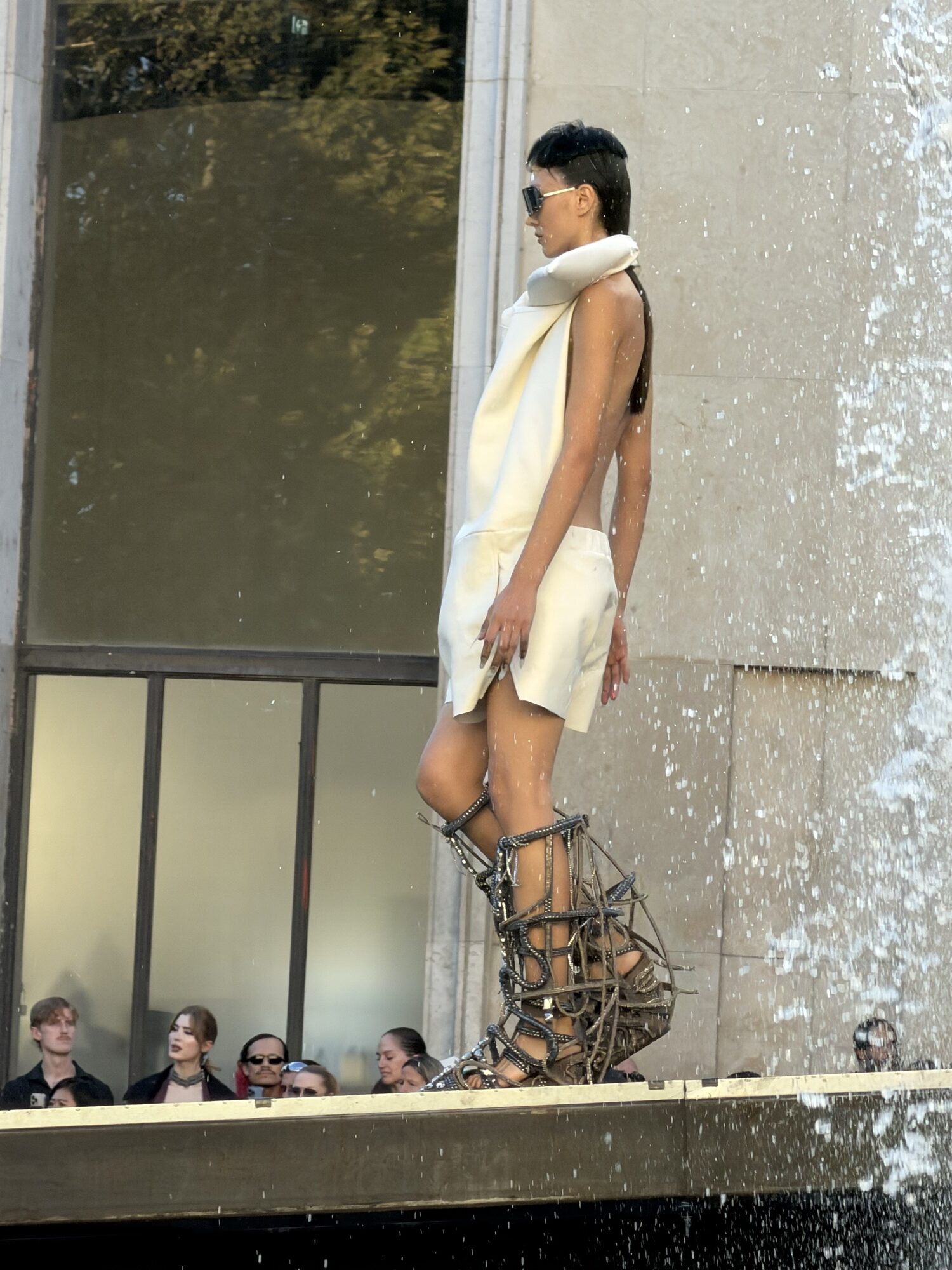
That conversion matters. A strap designed to bind cargo becomes a textile; a textile becomes a garment; a garment gives the body an architectural outline. Nothing in that sequence asks us to forget the material’s first purpose. Instead, the work changes its use without erasing its history. The webbing keeps its association with restraint and transport even as the fabric becomes sumptuous. The contradiction is part of the surface.
Elsewhere, the collection measured time differently. A dense silk duchesse woven in the Como region yields only about thirty meters a day. The millefoglie jackets took another kind of patience: thousands of individual circles of recycled nylon tulle, each sewn onto a base before the surface was shaped to the body and joined to heavy cotton poplin. A jacket required about forty-five hours of work. These numbers are not incidental production facts. They make duration visible inside the finished object.
Clothing often appears in public as an image of immediacy: the look, the entrance, the photograph, the next look. Here, the garment carried its making with it. Slowness was not presented as nostalgia or purity. It was a condition of construction—one way of producing a form that could bear weight, detail, and attention.
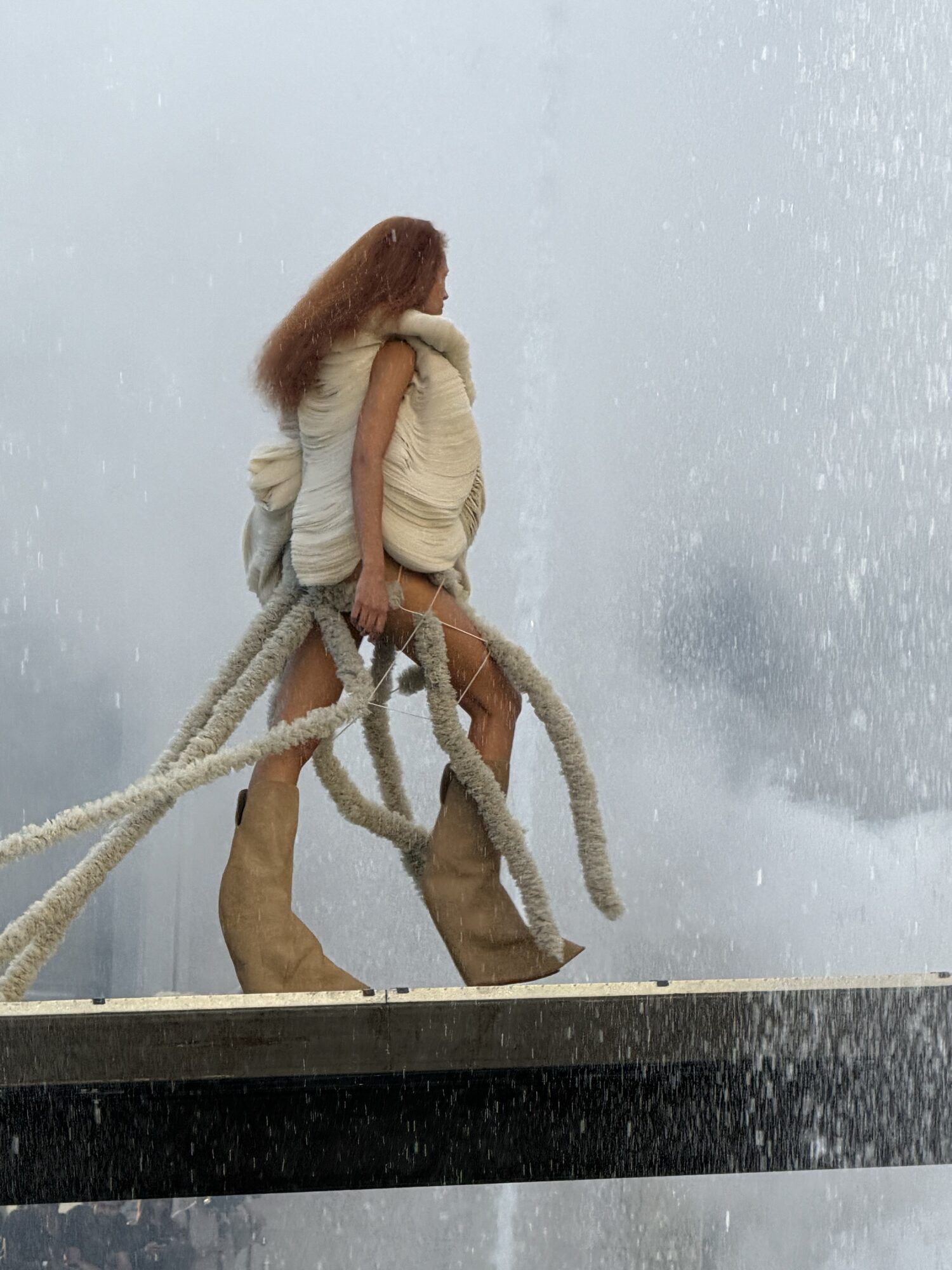
But the collection did not leave us in the realm of weight. Flowing pants, tunics, and microjackets in Japanese denim opened the silhouettes into movement. Lightweight lamb leather was hand-finished with waxes that would soften and fade with wear. The garments did not all aim at permanence in the same way. Some held their shape; some were designed to change. That difference makes the word stone more interesting. Endurance need not mean refusing time. It can also mean knowing what is allowed to alter.
The body in these clothes was not treated as a blank form waiting to be dressed. Slouchy skirts with deep pockets carried sharp bustles that emphasized the hollow of the lower back. Halter dresses framed that same area with winged collars. The silhouettes drew attention to the body by shaping the space around it: a line held open, a curve made structural, an absence given its own outline.
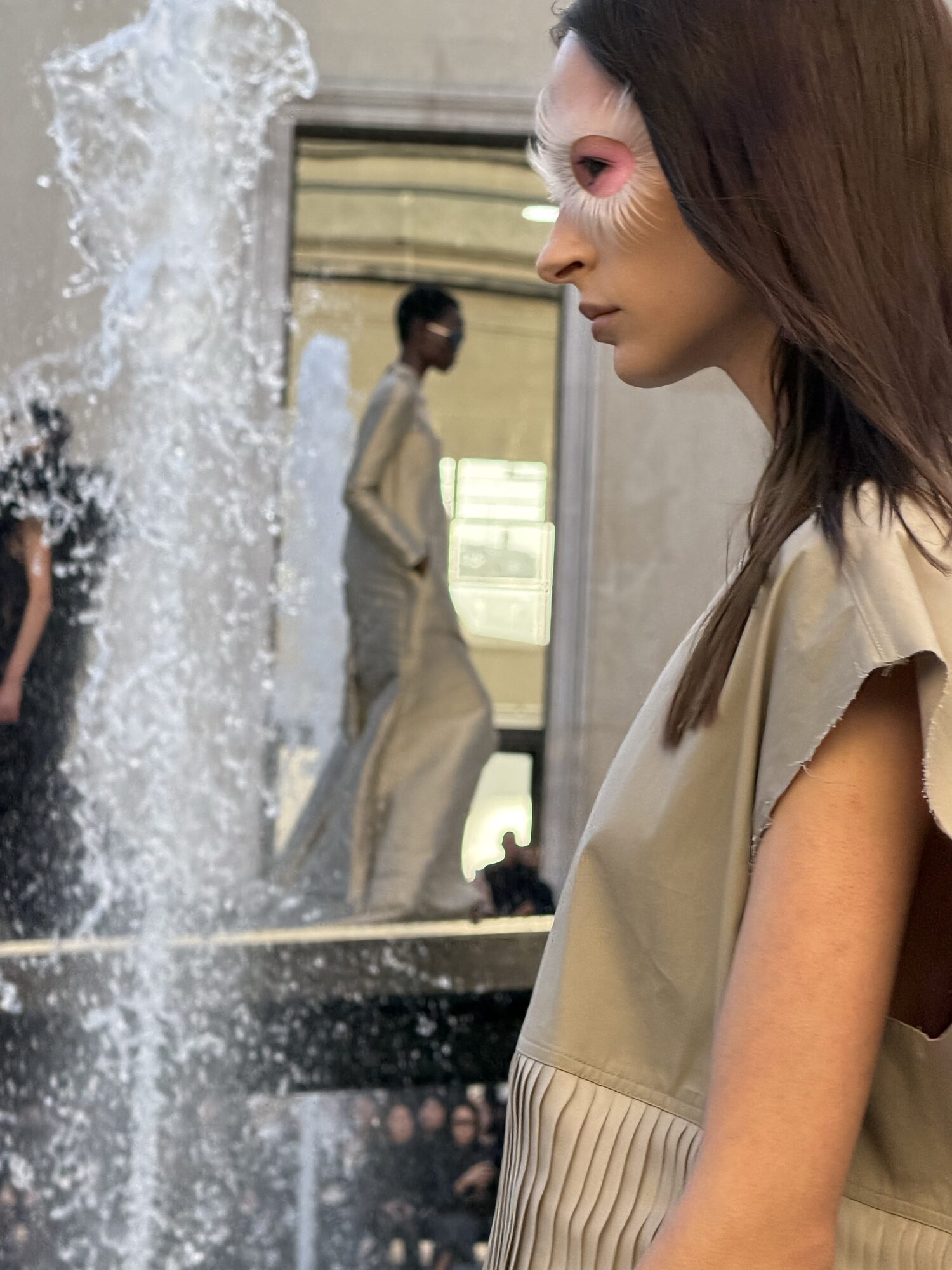
The tensegrity pieces made this logic explicit. Constructions that had appeared in latex and leather in an earlier men’s collection returned as frothy tulle négligées. Tensegrity describes a structure held between compression and continuous tension. In the body, bones are held in compression while connective tissues remain under tension. The principle belongs to engineering and anatomy, but on the runway it became a way to think about clothing: support without concealment, exposure without collapse.
The change from latex and leather to tulle did not dissolve the structure. It let us see it differently. Airiness could carry tension; softness could be part of a frame. That reversal is one of the collection’s clearest answers to the idea of strength. A structure need not announce its force through hardness alone. Some forms hold because their parts remain responsive to one another.
The pentagrams extended the argument from the body into the realm of belief. Owens has described them as a protest against judgmental condemnation and intolerance, against the impulse to demonize what is unfamiliar. The star is a symbol that can be used to draw a boundary around an idea of the forbidden. Here, he turned it toward the possibility of an open heart.
That gesture is deliberately modest. It does not claim that a garment can settle the conditions that make people targets, or that a runway can substitute for political action. It does make visible a choice about what symbols are allowed to do. A mark associated with fear can be taken up and redirected. The work does not pretend the history disappears; it asks whether the meaning can be changed through use.
This is where the show’s water and the collection’s materials begin to speak to one another. Water moves across the image of the runway; the garments move between rigid cloth and floating tulle, durable leather and surfaces meant to soften, compression and tension. The symbols resist a single fixed reading. Again and again, the collection makes room for two conditions to remain present at once.
The word stone can describe the obstruction, the instrument of harm, or the thing moved aside. Those meanings do not become identical. They do, however, leave open a question about what we do with the strength we have: whether it hardens into a wall, becomes a weapon, or helps clear a way through.
By the end, I was thinking less about the show as a sequence of looks than as a set of relations: cloth to body, structure to movement, symbol to the person who reads it, audience to performance. The mist had crossed into the crowd; the clothes kept their tensions in view. The day remained beautiful. What stayed with me was not a simple opposition between stone and water, or hardness and softness, but the possibility that strength might be measured by what it can keep open.